
Author: Guo Yongying, Xu Lu / Release time: 2026-11-25
From the global success of Black Myth: Wukong, the worldwide popularity of LABUBU and the North American theatrical release of Ne Zha to the continued overseas expansion of online novels and micro-dramas, Chinese IP globalization has moved from isolated blockbusters to large-scale exports. A growing number of cultural and entertainment enterprises are planning distribution, licensing and derivative operations in the U.S. market.
Nevertheless, a common view holds that since China and the U.S. are both members of the Berne Convention, works are automatically protected upon creation and no U.S. registration is needed.
This judgment is only half correct. Automatic protection answers whether rights exist, but not whether rights are enforceable. Unregistered works face clear shortcomings in damage claims, customs enforcement and commercial transactions.
I. Automatic Protection, Yet Far from Sufficient
Under the Berne Convention, Chinese works that are original and fixed in a tangible medium gain automatic protection in the United States without registration. However, this "protection" merely confirms that copyright exists. Works not registered with the U.S. Copyright Office have three major weaknesses when enforcing rights or conducting commercial transactions in the U.S.:
1. No access to customs protection. U.S. Customs and Border Protection (CBP) seizes pirated goods on the premise that the rightsholder has completed customs recordation, which requires a valid U.S. Copyright Office registration or a submitted registration application. Chinese domestic copyright registration certificates are not accepted by CBP. Once registered, the rightsholder files for customs recordation with the certificate issued by the Copyright Office, after which CBP enters the work information into its internal database; during later inspections, the system compares shipments against the recorded information and detains suspected infringing goods that are identical or substantially similar.
Chinese registration certificates cannot be used for CBP recordation for two reasons: first, copyright is territorial, and the U.S. customs system recognizes only U.S. Copyright Office records; second, under the Berne Convention, while registration may not be a condition of acquiring copyright, it may be set as a prerequisite for remedies such as customs enforcement. Without a U.S. registration certificate, customs recordation is unavailable, so pirated goods easily enter and circulate while brands cannot block infringement at the source.
2. High enforcement costs, low recovery. Works first published in China qualify as foreign works. While U.S. law permits Berne foreign works to sue without registration, the right to sue does not guarantee full compensation.
First, only actual damages or the infringer's profits may be claimed. For infringement occurring before the effective date of registration, statutory damages cannot be sought. The advantage of statutory damages is that the rightsholder need not prove actual loss; the amount is fixed by law. For unregistered works, the rightsholder must prove lost licensing fees, displaced sales or the infringer's gains. Such evidence is usually difficult to obtain against small overseas sellers and social-media accounts; even when proven, the award tends to be limited.
Second, attorneys' fees must be self-borne. U.S. copyright litigation is expensive; if infringement predates registration, a prevailing plaintiff cannot recover attorneys' fees. It is common in practice to "win the case but lose money."
3. Insufficient commercial recognition. Works not registered with the Copyright Office lack official, verifiable title records. Distribution and licensing in U.S. film, publishing and gaming industries generally require complete chain-of-title documents. For films released or launched on platforms, distributors often require producers to purchase Errors & Omissions (E&O) insurance covering claims arising from unclear copyright, infringement, portrait/privacy disputes, defamation and similar risks. Before underwriting, insurers search Copyright Office registration and assignment records to verify the chain of title; when producers secure financing secured by copyright, lenders likewise check U.S. registration records for prior security interests or title conflicts. Relying solely on "automatically acquired copyright" without publicly retrievable U.S. Copyright Office records makes due diligence difficult for counterparties and impedes closing.
Note: Affixing ©, Chinese domestic registration or industry filings does not equal U.S. registration; only a registration decision and certificate issued by the U.S. Copyright Office counts. Once approved, registration takes effect retroactively to the date the Copyright Office receives the complete application, so early filing itself matters.
II. What U.S. Registration Brings to Global IP
Put simply, registration remedies the gaps in automatic protection and gives works full enforceability in the U.S.
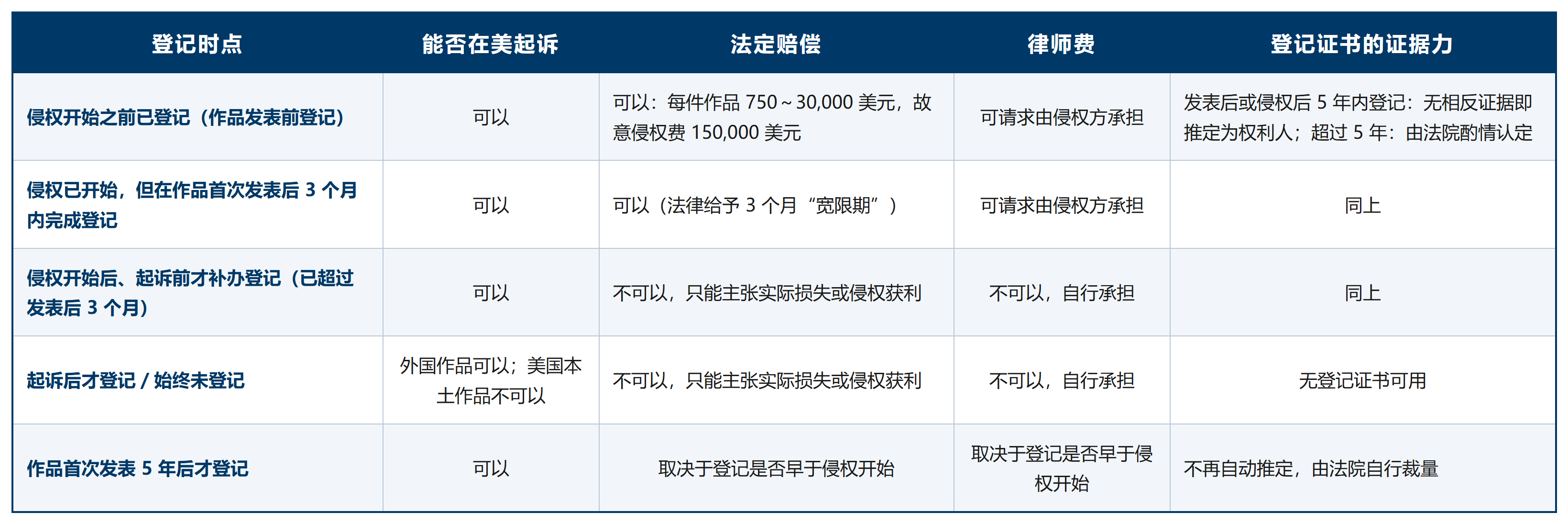
1. Make enforcement real. Timely registered works qualify for statutory damages and recovery of attorneys' fees. Statutory damages need no proof of actual loss: USD 750–30,000 per work, up to USD 150,000 for willful infringement. For overseas rightsholders, this means deterrent compensation even when evidence is hard to gather. The prerequisite: registration before infringement begins, or within three months after first publication. Registration completed after infringement starts, even before filing suit, cannot support statutory damages or fees for that infringement.
Notes: ① Registration within five years of publication affects evidentiary weight, not the compensation amount; ② statutory damages are calculated per work, not per infringing act; ③ attorneys' fees are awarded at court discretion and are not guaranteed on victory; ④ if the infringer proves innocent intent, statutory damages may drop to USD 200 per work.
2. Greatly reduce the evidentiary burden. Works registered before first publication or within five years after it give a registration certificate that constitutes prima facie evidence in litigation. With the certificate, the court presumes the named rightsholder is the lawful owner, the work is original and copyright is valid; the burden shifts to the defendant to rebut with substantive evidence. This presumption does not eliminate all supplementary evidence, but it spares the plaintiff from preparing a full set of ownership archives, translations and notarizations to prove originality and title, cutting evidence costs substantially. If registered more than five years after first publication, the certificate loses this statutory presumption; its weight is assessed at court discretion.
3. A strong endorsement for overseas commercial cooperation. U.S. counterparties generally favor publicly searchable Copyright Office records in due diligence. After registration, the information enters the public Copyright Office database for anyone to verify, facilitating chain-of-title review, reducing ownership concerns and advancing licensing, distribution and other deals.
III. Scenarios Where Registration Is Mandatory
Some overseas activities make U.S. registration a statutory prerequisite; without it, access to the channel is restricted.
1. Seeking U.S. customs seizure of pirated goods. For exports of publications, cultural products and IP merchandise to the U.S., copyright registration must be completed before customs recordation to enable CBP interception.
2. Using the Copyright Small Claims program. Registration is a prerequisite for relief through the Copyright Small Claims Board (CCB). Launched in 2022 by the Copyright Office, the CCB is a voluntary alternative to federal district courts for copyright disputes seeking total damages under USD 30,000, targeting frequent low-value infringements such as online scraping and minor commercial use. Features: (1) Low cost: fully online; no in-person U.S. hearing and no mandatory U.S. counsel. Filing fees total USD 100 in two installments (USD 40 at filing, USD 60 after the respondent answers). (2) Damage cap: USD 30,000 per case; statutory damages capped at USD 15,000 per work, halved for works without timely registration. (3) Registration threshold: the work must be registered or at least have an application filed at filing. (4) Voluntariness and territorial limit: respondents may opt out within 60 days of service; the CCB applies only to U.S.-located respondents, suiting disputes with U.S. social-media accounts and small online stores.
IV. High-Value IP Recommended for Early Registration
Beyond mandatory cases, the following categories are recommended for early registration from a long-term operation view:
1. High-production-cost IP needing long-term anti-infringement protection. Scripts, long-form content and original animations that involve heavy investment struggle to recover losses from mass scraping and commercial use without registration; early registration enables direct statutory-damages claims upon infringement.
2. IP needing overseas valuation, financing or asset recognition. Unregistered works can only prove ownership through internal documents, raising due-diligence difficulty and valuation discounts. Registered works become IP assets searchable in the official U.S. system, easing investor and auditor title due diligence and facilitating copyright-secured financing.
3. Works with complex title chains: translations, adaptations, commissioned creations. Note the Sino-U.S. difference: in China, commissioned-work copyright vests in the commissioned creator absent agreement; in the U.S., commissioned works qualify as works made for hire only within statutory categories and with written agreements. Sort out the chain and complete written assignments before registration; for adaptations and translations, disclose pre-existing works—registration protects only newly added elements.
4. Serial works for long-term U.S. deployment. Post-publication registration is not rejected, but statutory damages and fees cannot be claimed for infringement starting before registration; registering after five years also forfeits the presumption. Serial works may use group registration for low-cost batch filings.
V. Effect of the Registration Certificate
Upon approval, the Copyright Office issues a certificate and enters registration data in the public catalog, usable for title verification, commercial contracting, platform enforcement, customs recordation and litigation. Registration takes effect when the Copyright Office receives the complete application, not on certificate issuance.
When publishing, use proper © notice: © [Year of First Publication] [Rightsholder Name] (e.g., © 2026 XX Culture Co., Ltd.). The notice is not a protection condition but may bar innocent-intent reductions.
VI. Practical Features and Common Risks
U.S. registration is filed online; though simple-looking, it has thresholds. Wrong work classification, non-compliant deposit copies or unclear ownership trigger office actions and lengthen timelines; serious cases are rejected, and correspondence stays on file for opposing counsel to exploit.
Additionally, fully AI-generated content receives no U.S. copyright protection. Works containing AI material must truthfully disclose it and exclude it from registration; concealment may lead to cancellation or invalidity. Teams heavily using AI in micro-dramas and animations should take particular note. The core difficulties lie in work classification, title sorting, deposit preparation, AI disclosure and office-action response, all requiring practical experience.
VII. Closing
Returning to the opening question: is U.S. registration necessary? Copyright acquired automatically under conventions answers whether rights exist; to recover damages, block piracy and withstand due diligence in the U.S., official registration is the foundation. For entertainment IP targeting long-term overseas markets, U.S. registration is not an optional bonus but basic infrastructure—and earlier registration unlocks more remedies.
Our team's attorneys hold overseas degrees and cross-border practice experience. We handle U.S. copyright registration and cooperate with U.S. counsel on U.S. trademark applications (the USPTO requires foreign applicants to retain U.S. licensed counsel), delivering IP strategic planning for enterprises entering the U.S. market.
For inquiries, please message us via the back-end channel.
Appendix: Cited Authorities
I. International Treaty
Berne Convention for the Protection of Literary and Artistic Works (Paris Act, 1971), Arts. 3(4), 5(1), 5(2)
II. U.S. Law2. Copyright Act of 1976, 17 U.S.C. § 101 et seq. § 101 (definitions of "United States work," "work made for hire"), § 103, § 201(b), § 205, § 401(b), § 401(d), § 410(c), § 410(d), § 411(a), § 411(b), § 412, § 504(b), § 504(c), § 505 3. Copyright Alternative in Small-Claims Enforcement Act of 2020, codified at 17 U.S.C. §§ 1501–1511, § 1504(d)(4), § 1504(e)(1), § 1505, § 1506(i)
III. U.S. Federal Regulations4. 19 C.F.R. §§ 133.31–133.33 (Customs Copyright Recordation) 5. 37 C.F.R. § 2.11(a) (foreign trademark applicants must retain U.S. licensed counsel), § 202.4 (group registration), § 202.5 (reconsideration) 6. U.S. Copyright Office, Copyright Registration Guidance: Works Containing Material Generated by Artificial Intelligence, 88 Fed. Reg. 16190 (Mar. 16, 2023)
IV. U.S. Case Law7. Fourth Estate Public Benefit Corp. v. Wall-Street.com, LLC, 586 U.S. 296 (2019) 8. Thaler v. Perlmutter, 130 F.4th 1039 (D.C. Cir. 2025)
V. Chinese Law9. Copyright Law of the People's Republic of China (Rev. 2020), Art. 19
This article is for general information only and does not constitute legal advice on any specific matter.
Next: There is no more.