Release time: 2023-12-04
I. What is an Industrial Design
The so-called design is essentially a "new design". There are essential differences between design and the other two types of inventions-creations provided for in the Patent Law, namely "invention" and "utility model", for the essence of the latter two is "new technical solutions".
Regarding industrial designs, an explicit definition is set out in Paragraph 4 of Article 2 of the Patent Law of China: "An industrial design refers to any new design of the shape, pattern, or a combination thereof, as well as the combination of color with shape and/or pattern, of the whole or part of a product, which is aesthetic and suitable for industrial application."
II. Scope of Protection of Industrial Designs
(I) Images and Photographs
Paragraph 2 of Article 64 of the Patent Law of the People's Republic of China explicitly stipulates the scope of protection of the design patent right, that is, such scope shall be determined on the basis of "drawings" and "photographs", and the brief description may be used to interpret the design of the product as shown in the aforesaid drawings or photographs.
(II) Shape, Pattern and Color
The definition of design set out in Paragraph 4 of Article 2 of the Patent Law explicitly specifies the manifestations of a design, namely shape, pattern and color (including combinations of the aforesaid three elements).
(III) Design Features
Paragraph 2 of Article 23 of the *Patent Law of the People's Republic of China* stipulates that: "A design for which a patent right is granted shall be obviously different from prior designs or combinations of prior design features." The so-called obvious difference mentioned herein actually refers to new design features (including combinations thereof), which need to be embodied by elements such as shape, pattern and color, and therefore fall within the protection scope of designs.
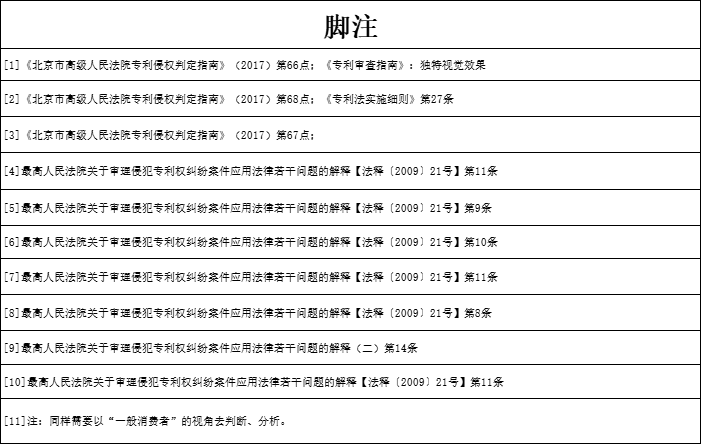
What is a design feature? It refers to the design of a certain part of a product, which has relatively independent visual effects. [1] It shall be noted that the element of "color" per se can also be regarded as an independent design feature. [2] There is a subordinate concept under design feature, namely design key point, which refers to the design feature that distinguishes itself from prior designs and can exert a significant visual impact on ordinary consumers. [3]
III. Determination of Design Infringement
1. Object of Comparison
Allegedly Infringing Design (Product) VS Granted Design [4]
2. Identical or Similar Products
Judgment Standard: Product Use
Reference Factors [5]
(1) Brief Description of the Design
(2) International Classification of Industrial Designs
(3) Functions of the Product
(4) Sales Status of Products
(5) Usage of the Products
3. Identical or Similar Design
Subject of Judgment: Average Consumer (level of knowledge and cognitive ability)[6]
Method of Determination:
(1) Comprehensive observation of design features
(2) Conduct a comprehensive judgment on the overall visual effect
4. Conclusion
(1) Overall visual effect: no difference → identical [7]
(2) Overall visual effect, no substantive difference → Similar
(3) The overall visual effects are different with marked distinctions → not identical / similar
To determine whether an act constitutes infringement of a design patent[8], the following two conditions shall be met concurrently:
The two products fall within the same or similar category.
(2) The two designs are identical or similar.
When determining design patent infringement, a comparison is conducted between the accused infringing design (product) and the granted design. The direct conclusion drawn therefrom is whether the accused infringing design falls within the scope of protection of the granted design right, rather than a direct conclusion on whether patent infringement is constituted, which is a distinction in conceptual expression. Even if the accused infringing design falls within the protection scope of the design patent, it does not necessarily constitute patent infringement, as Articles 67 and 75 of the Patent Law also provide for statutory defenses such as prior design defense and circumstances where relevant acts are not deemed as infringement.
The primary consideration for determining whether the product incorporating the accused infringing design and the product incorporating the granted design are identical or similar products is the use of the products. Where it is difficult to determine the use of the products, the brief description of the design, the International Classification for Industrial Designs, as well as the functions, sales status and usage of the products shall be taken as auxiliary reference factors.
The subject of infringement determination is actually a hypothetical "person", who possesses the knowledge level and cognitive competence of an ordinary consumer. The characteristics that the so-called "ordinary consumer" shall have are explicitly stipulated in the *Guidelines for Patent Examination*: (1) They have common knowledge of the designs and common design methods of products of the same or similar categories prior to the filing date of the involved patent; (2) They have certain ability to distinguish the differences in shape, pattern and color between design products, but will not notice minor changes in the shape, pattern and color of such products. On the other hand, when making a determination from the perspective of an ordinary consumer, another factor shall be taken into consideration, namely the design space of products of the same or similar categories to which the granted design belongs at the time when the alleged infringing act takes place. Where the design space is small, subtle differences will exert a relatively great impact on the overall visual effect; where the design space is large, subtle differences will not produce a significant impact on the overall visual effect.[9]
There are two main approaches for determining whether designs are identical or similar:
First, a comprehensive observation of [Design Features] (Independent Determination) shall be conducted, that is, each design feature shall be separately extracted for observation and comparison.
Second, a comprehensive judgment shall be made on the [overall visual effect] (overall comparison), that is, factors that may affect the overall visual effect of the product's appearance design shall be comprehensively considered.
When comparing design features, it shall be noted that the parts of a product that are easily directly observable during use, as well as the design features distinct from prior designs, generally have a greater impact on the overall visual effect of the design.
Many people only take the first two points into account when determining whether designs are identical or similar. As a matter of fact, relevant judicial interpretations include separate proviso provisions on this issue[10], which stipulate that design features determined by technical functions shall not be considered, nor shall features such as materials and structures that have no impact on the overall visual effect. It is fairly easy to understand why features that do not affect the overall visual effect are excluded from consideration, but why are design features determined by technical functions also excluded? The reason is straightforward: functional design features, in essence, are means and methods for realizing "functions", and can hardly be deemed as aesthetic designs. What are functional design features? They seem to be commonly understood as the sole design that realizes a specific function, but that is not the case. Multiple designs for realizing a specific function[11] may also fully constitute functional design features. For specific analysis, please refer to the Judgment of Case (2015) Min Ti Zi No. 23, and the author will not elaborate further herein.
IV. Conclusion
Regarding the determination of design infringement, the core criterion rests on the "overall visual effect". Where there is no difference in the overall visual effect, the designs may be determined as identical; where there is no substantial difference in the overall visual effect, the designs may be deemed as similar. By the same token, where the overall visual effects are not identical, the conclusion shall be that the designs are neither identical nor similar.
In the determination of design patent infringement in judicial practice, the comparison conducted in most cases is rather rudimentary, which is limited only to [individual assessment] and [overall comparison]. Based on the provisions of relevant laws, the author has developed a relatively clear, comparatively sound and maximally universally applicable analytical framework for the determination of design patent infringement. If circumstances including the defense of legitimate source, non-infringement defense and other special designs are taken into account, there are still a great many aspects pending further improvement and optimization.