
Author: Zhonghao Chen / Release time: 2026-09-04
As an avid fiction reader, I have long admired Jiang Nan. I am thoroughly familiar with his works such as Dragon Raja and the Kyushu Series. Yet The Youth of This Moment, the work central to this discussion, is one of the few Jiang Nan books I have not read. As a lawyer specializing in intellectual property cases, I followed closely the lawsuit between Jiang Nan and the celebrated writer Jin Yong over The Youth of This Moment. Known as the “first fan‑fiction copyright case”, the dispute Cha Liang‑yong (Jin Yong) v. Yang Zhi (Jiang Nan) concerning copyright infringement and unfair competition went through first‑instance and second‑instance hearings over seven years and drew widespread public attention. The two‑level courts reached markedly different reasoning. Puzzled by these judgments, I studied the rulings and formed the reflections set forth in this article.
Fan‑fiction generally refers to secondary creative works built upon characters, storylines, world‑building settings and other elements from existing novels, animations, films, television shows or video games. Fan‑fiction abounds in today’s online‑literature landscape. When an online novel becomes a smash hit, countless derivative works spring up based on its characters, cultivation systems and other components, churning out “new works” almost assembly‑line‑style. Story arcs that readers hoped to see in the original work may materialize in fan‑fiction. From my practice, popular online novel authors hold mixed attitudes toward fan‑fiction: some explicitly offer creative guidance and permit secondary creation within reasonable bounds; others issue takedown requests or publicly criticize fan‑works. Commercially, fan‑fiction can boost the original work’s reach and popularity. From a copyright‑law perspective, however, critical questions remain: where lies the legal boundary for fan‑fiction creation? Do character names, personalities and relationships detached from concrete plots count as unprotected “ideas”, or as protected “expressions”?
This article analyzes the landmark case Cha Liang‑yong v. Yang Zhi to explore the above‑mentioned questions.
I. Case Facts and Two‑Trial Outcomes: One Set of Facts, Two Divergent Views
Jin Yong’s masterpieces The Legend of the Condor Heroes, The Smiling, Proud Wanderer, Demi‑Gods and Semi‑Devils and The Return of the Condor Heroes were published in mainland China by SDX Joint Publishing Company in May 1994. Reprinted many times, these titles have been included in textbooks across mainland China, Hong Kong and overseas and adapted into numerous films and television dramas; their characters are household names. Defendant Yang Zhi, writing under the pen‑name Jiang Nan, authored The Youth of This Moment. He transplanted dozens of Jin‑yong‑created figures — Guo Jing, Huang Rong, Yang Kang, Mu Nianci, Qiao Feng, Kang Min, Linghu Chong and others — into a fictional university to tell entirely original coming‑of‑age campus stories. First published in 2002, the book went through five editions and sold more than one million copies. Jin Yong filed suit in 2016, alleging infringement of adaptation right, attribution right, integrity‑of‑work right and a “commercial‑use‑right‑in‑characters”, plus unfair competition, and claimed damages of RMB 5 million. Cha Liang‑yong passed away during the appeal proceedings; his heir Lin took over the litigation.
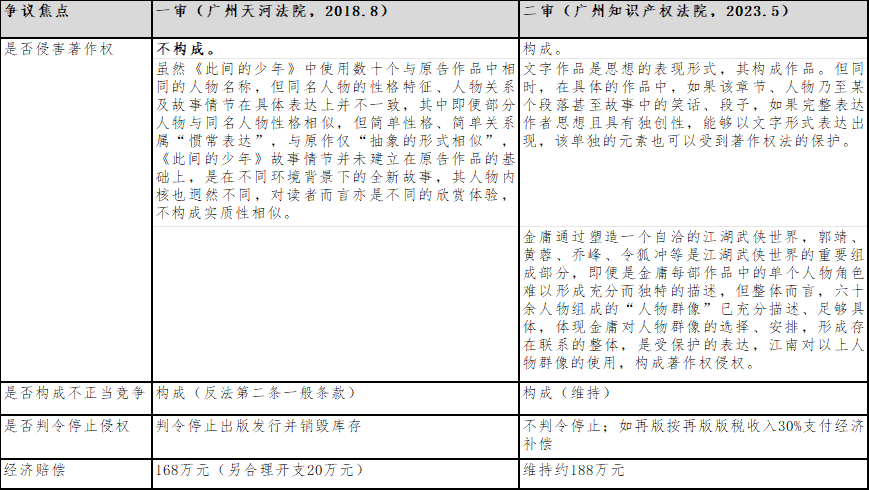
It merits emphasis that the entire divergence between the two rulings turns solely on copyright. Identical source material yielded a finding of non‑infringement at first instance and infringement on appeal. This divide illustrates the flexible application of the idea‑expression dichotomy when evaluating literary characters.
II. The Dispute Turns on the Granularity of Comparison
The bedrock principle of copyright law is that it protects expression, not ideas. In my view, the conflicting judgments hinge on how finely courts dissect and compare character‑related elements.
(A) The element‑by‑element decomposition approach of the first‑instance court
The first‑instance court broke characters down into discrete building blocks: names, relationships, personality traits. It held that bare names (e.g. the two‑character name “Guo Jing”), simple personality labels (honest and slow‑witted, mischievous and quick‑witted), and basic interpersonal bonds (Guo Jing and Huang‑Rong as lovers) represent stock literary devices functioning chiefly as identifying symbols. No substantial similarity existed; The Youth of This Moment amounted to independent original creation rather than an adaptation. This reasoning draws heavily on Professor Wang Qian’s article Initial Exploration into Copyright Infringement by Fan‑Fiction.
(B) The holistic‑comparison approach of the second‑instance court
Rather than isolating individual names or relationships, the appellate court examined the integrated group of over sixty figures. It ruled that this character ensemble, richly depicted and logically interlinked, transcends abstract ideas and qualifies as protectable expression.
(C) Author’s observation
The first‑instance court saw separate pearls; the appellate court saw a complete pearl necklace strung together. The same building‑blocks may count as ideas when isolated yet become expression when assembled. Both methodologies possess internal merit; the real difficulty lies in drawing the line between discrete elements and an integrated whole. I incline toward the holistic appellate reasoning. Literary originality resides precisely in the organic interplay of names, temperaments, relationships and fictional backgrounds. If courts dissect works down to minimal units, nearly every feature risks being consigned to the public domain, frustrating copyright’s purpose of rewarding creative labour. Still, holistic review must not be over‑extended. Courts must verify whether characters receive “sufficiently concrete, detailed depiction” and tie into specific plot‑lines before finding infringement merely because numerous shared character names appear. That limiting standard — “sufficiently described and concretely rendered” — supplies the critical doctrinal threshold for future analogous cases.
III. Literary Characters Gain Protection Together with the Work, Not as Freestanding Rights
This case delivers an important lesson for contemporary creators: literary characters cannot stand alone as independent copyright subject‑matter. Both courts rejected the purported freestanding “commercial‑use‑right‑in‑characters”. No such statutory right exists; textual literary figures lack the visual tangibility of graphic or cinematic characters, so this asserted right lacks legal grounding.
Non‑recognition of standalone character rights does not mean characters receive zero protection. Protection turns on originality and concreteness. Bare names or archetypal personalities (Mongolian origins, simple honesty) fall within ideas or the public domain open to all writers. By contrast, fully‑realized, plot‑embedded characters — especially cohesive character ensembles — may manifest originality and qualify as protected expression as part of the parent work.
Character‑protection analysis is not a binary yes‑or‑no test; it requires case‑by‑case weighing of how thoroughly a character is fleshed‑out. The appellate court did not protect the mere name “Guo Jing”; it protected the whole set of vividly‑portrayed character‑expression systematically appropriated in The Youth of This Moment.
IV. Dual‑Track Remedies: Copyright and Anti‑Unfair‑Competition Law
Notably, both courts applied Article 2, the general clause, of the Anti‑Unfair Competition Law. Even while rejecting copyright infringement, the trial court still found unfair competition. Senior judges of the Civil Division III of the Supreme People’s Court have clarified that the general clause operates as a backstop supplementing specialized intellectual‑property statutes. It supplies relief where certain work‑elements (e.g. character names) lie outside copyright scope yet carry substantial commercial value misappropriated by others.
Three prerequisites established in the landmark Shandong Food Company case ((2009) Min Shen Zi No. 1065) govern application of this general clause: (1) no specific statutory provision covers the conduct; (2) the right‑holder suffers actual harm to legitimate interests; (3) the conduct violates good‑faith principles and accepted commercial ethics and is therefore blameworthy.
The court found that Yang Zhi leveraged Jin Yong’s market prestige to attract large readership, seizing market opportunities that Jin Yong might otherwise have exploited. The original subtitle “The University‑Age Adventures of the Condor Heroes” constituted obvious opportunistic free‑riding, supplying evidence of bad faith and supporting unfair‑competition liability. This creates a clear remedial framework: pursue copyright claims where expression qualifies for copyright protection; invoke anti‑unfair‑competition law as a safety net for commercially‑valuable elements misappropriated in bad faith. Courts must exercise restraint applying the general clause; where specialized statutes already offer complete regulation, over‑reliance on this fallback provision risks undue interference with free market competition.
V. Balancing of Interests Behind the Denial of a Cease‑and‑Desist Order
Though finding copyright infringement, the appellate court declined to order the book withdrawn from circulation, instead imposing an obligation to pay 30 % of royalties from any future reprints. I consider this outcome consistent with copyright’s legislative goals, exemplifying a modern shift away from automatic injunctive relief toward interest‑balancing analysis.
Copyright law aims both to safeguard creators’ entitlements and to foster creation and dissemination for societal cultural and scientific advancement. Remedies for copyright violations normally include injunction against further infringement, damages, apology and rectification of adverse impact. Punitive damages apply for egregious violations.
The trial court ordered cessation of publication and destruction of inventory. The appeal court refused an injunction, opting for royalty‑based compensation for future print‑runs. Judges reasoned that The Youth of This Moment (campus youth fiction) and Jin Yong’s martial‑arts novels target different readerships and can co‑exist culturally. A blanket ban would waste completed cultural goods and disregard diverse public reading demands. Injunctive relief is not mandatory upon a finding of infringement. When continued exploitation yields greater social benefit and monetary damages can fully compensate the right‑holder, courts may reasonably withhold injunctions. For the fan‑fiction ecosystem, this signals measured judicial tolerance for secondary creation.
VI. Practical Advice for Creators
Fan‑fiction and secondary‑creation output proliferate across web‑literature communities, drawing upon popular novels, television series and animations. Even when original authors have not explicitly forbidden derivative works, secondary creators should bear the following practical guidance in mind:
Be wary of systematically transplanting established character ensembles. Using one or two isolated archetypal names carries low risk. Mass importation of an original work’s full character cast, personalities and relational networks designed to trigger readers’ recognitional pleasure greatly heightens legal risk of crossing into protected expression.
Distinguish non‑profit‑oriented versus commercial publication. Non‑commercial secondary works offering fresh aesthetic perspectives and constructive dialogue with the original receive more lenient legal assessment. Commercial mass‑publication easily crosses acceptable boundaries and triggers unfair‑competition liability.
Avoid parasitical marketing tactics. Using the original work’s renown directly to promote derivative works (for instance via suggestive subtitles) furnishes powerful evidence of opportunistic subjective intent.
Prior authorization represents the safest pathway. The appellate judgment notes that securing permission from original authors enables lawful reprinting, satisfies diverse reader demand and advances cultural flourishing. Prior licensing permits win‑win outcomes and mitigates legal exposure.
Conclusion
From first‑instance non‑infringement under element‑wise dissection to appellate infringement via holistic‑work analysis, the seven‑year‑long “first fan‑fiction case” sharpens the legal boundaries for literary‑character copyright protection. Isolated names function as mere signs; systematically, richly‑developed character ensembles qualify as protectable expression. The ruling respects original authors’ legitimate interests in their creative output, while its flexible remedy — no publication ban plus monetary compensation for future editions — preserves breathing room for secondary creation. In the absence of dedicated statutory provisions governing fan‑fiction, this case supplies highly persuasive jurisprudence: conduct substantial‑similarity assessment, deploy anti‑unfair‑competition law as supplementary safety‑net relief, and apply interest‑balancing principles when shaping remedies.